Asphalt Repair in Knoxville, TN
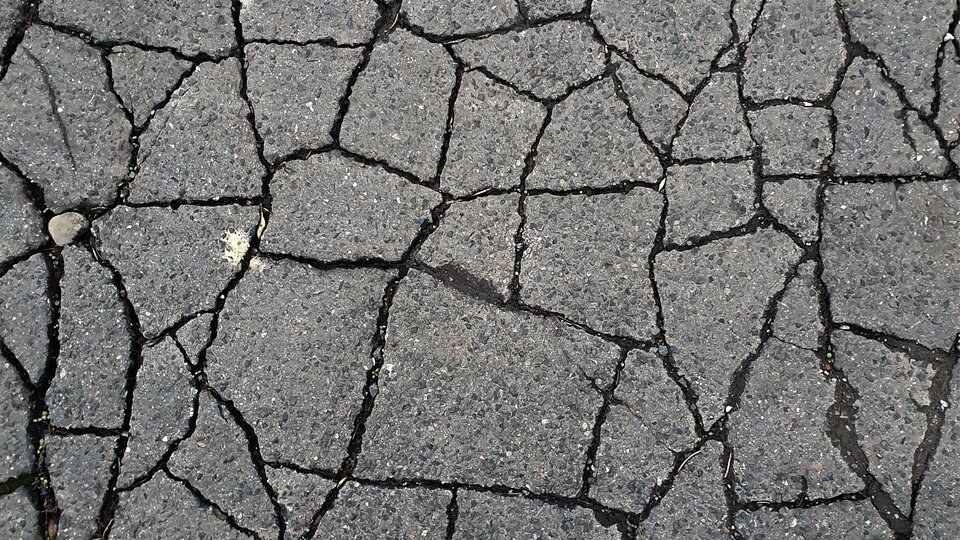
Most asphalt failures in Knoxville start as something small that water got into. Fixing them early is cheap. Waiting turns a crack into a pothole and a pothole into a base problem. Call (865) 500-5861 for a free quote.
How Asphalt Fails Here
Cracks come first. Hairline at the start, from oxidation, settling, or ordinary shrinkage. Harmless in themselves — the problem is that they’re an opening.
Then water gets in. East Tennessee gets about four feet of rain a year. Water finds the crack, runs down into the base.
Then it freezes. This is where Knoxville is unusual. We don’t stay frozen — we go through dozens of freeze-thaw cycles a winter. Each one freezes the water in that crack, expands it, widens the crack, then thaws and lets more water deeper. Sixty times a season. That cycle is what turns a crack you could’ve filled for very little into a pothole.
Then the base goes. Saturated base loses strength, the surface loses support, and now you have alligator cracking or a soft spot. At that point it’s not a surface repair anymore.
The whole chain starts with a crack and water. That’s why crack filling is the highest-return maintenance there is on asphalt.
What We Repair
Crack filling — cleaning and sealing cracks before they become anything else. Cheap, fast, and the single best thing you can do for a driveway that’s otherwise sound.
Pothole patching — cutting out the failed material and replacing it properly. Throwing cold patch in a hole and driving off isn’t a repair, it’s a delay.
Full-depth repair — when the base has failed in an area, the fix is excavating down, rebuilding the base, and repaving that section. More work, but it’s the only thing that holds.
Edge repair — asphalt edges without support crumble. Common on driveways with no shoulder.
Crack Sealing and Crack Filling, Done Properly
The two words get used interchangeably and they are not quite the same job. Crack filling puts a cold or hot-applied material into the crack to keep water out. Crack sealing routes the crack to a consistent shape first, then places a hot rubberized sealant that bonds to the walls and stays flexible as the pavement moves through the seasons. Sealing costs more and lasts longer, and on a working crack that opens and closes through a Knox County winter it is usually the one worth paying for. Asphalt crack repair on a surface that is otherwise sound is the cheapest work there is on a driveway, whichever of the two it calls for.
Crack filling sounds trivial and mostly isn’t. A crack that’s just topped off with sealer traps dirt and water and reopens by spring. Done right, the crack gets cleaned out first — blown clear of debris and vegetation, and on wider cracks routed to a consistent shape so the filler has something to key into. Then a flexible, usually hot-poured rubberized filler goes in, deep enough to seal and elastic enough to keep moving with the pavement through freeze-thaw instead of cracking loose from it. That flexibility is the whole point: East Tennessee asphalt expands and contracts constantly, and a rigid filler just becomes a new crack. Filled this way, a crack is genuinely closed against water — which is the entire game, because water in the base is what every larger failure grows from.
Patching a Pothole So It Stays Fixed
A pothole is a hole because the material and the base under it failed, so a real patch deals with both. We square up and cut out the failed area back to sound edges rather than filling a ragged hole, clean and, where needed, rebuild the base beneath, apply a tack coat so the new asphalt bonds to the old, then fill and compact in lifts to match the surrounding grade. The alternative — shovel cold-mix in, tamp it with a boot, drive away — is what you see on a lot of quick jobs, and it pops back out within a season because nothing stuck to the old asphalt and nothing got compacted. One approach is a repair; the other is a way to have the same pothole again next year.
When the Base Has Failed
Sometimes the honest finding is that the problem isn’t the surface at all. A soft spot that flexes under a rolling tire, or alligator cracking spreading across an area, means the base underneath has lost its strength — usually to water that got in and stayed. You can’t patch your way out of that from the top. Full-depth repair means excavating the failed section down past the bad base, rebuilding it with properly compacted stone, and repaving. It’s more work than a surface patch, but on a localized failure it’s the only thing that holds — and it’s far cheaper than letting the soft area spread until the whole drive needs replacing.
Standing Water and Low Spots
A driveway that holds a puddle — a “birdbath” — after every rain is telling you something before it cracks. Water sitting on asphalt has all day to soak in through any pore or hairline, and in this climate it will eventually freeze there. Low spots come from a settling base or a grade that was never right, and the fix is leveling and correcting drainage, not just sealing over the dip. Catching a birdbath while it’s still just standing water is a lot cheaper than catching it after it’s become a soft spot.
Repair or Replace?
Honest version: if the failures are isolated and the rest of the driveway is sound, repair. If you’re seeing alligator cracking across large areas, repairs are money into something that’s ending anyway, and a replacement is the better spend. We’ll tell you which one you’re looking at, including when it’s the cheaper answer.
Asphalt Repair FAQ
How much does pothole repair cost? Depends on size, depth, and how many. Free quote — call (865) 500-5861.
Is crack filling worth it? It’s the best value in asphalt maintenance. Filling cracks early prevents the water intrusion that causes everything worse.
When should cracks be filled? Any crack wider than about a quarter inch. Sooner is better, and before winter is best.
Can you patch in winter? Emergency patching, yes. Proper repairs want temperatures above 50°F, so major work waits for the season.
Why does my patch keep popping out? Almost always because it was cold-mix dropped in an uncut hole and never compacted or keyed into the surrounding asphalt. A cut-out, tacked, and compacted patch behaves like the pavement around it. If the same spot keeps failing, the base under it may have gone, which is a full-depth repair, not another surface patch.
Should I fix cracks before winter or wait until spring? Before winter, every time. Filled cracks keep water out of the base right when freeze-thaw is about to go to work on it. A crack left open in November is what becomes a pothole by March.
What does asphalt repair cost around Knoxville? Crack sealing generally runs about $1 to $3 per linear foot, and patching about $3 to $6 per square foot of the area actually being repaired — not of the whole driveway. Full-depth repair, where the base has to come out and be rebuilt, costs more per square foot than a surface patch because most of the work is underneath. Small numbers early are what keep you out of the replacement range.
When is a driveway too far gone to repair? The rough line is about a third of the surface. Once interlocking alligator cracking covers more than roughly 30% of the driveway, the base beneath it has already failed, and patching or overlaying is money spent on ground that will not hold it. Below that threshold repair is usually the right call and buys real years. Above it, repair is the expensive option, because you pay once for the patch and again for the replacement that follows.
Get Your Repair Quoted
Small problems are cheap. Call (865) 500-5861 before this winter turns them into big ones.